

China SIM Card
Super Detailed Steps: How to Stay Connected After Arriving in China
Staying connected in China is one of the first problems foreign travelers need to solve. The three most common options are international roaming, eSIM, and a local Chinese SIM card. In practice, roaming keeps your home number active while abroad, eSIM is a digital SIM built into supported devices, and a Chinese SIM card gives you a local number with in-country mobile service. The best choice depends on your phone, trip length, and how much convenience you want at the airport.
Super detailed guide for foreigners buying SIM cards in China. China Mobile, China Telecom, and China Unicom logos can appear here.
If you are landing in Xi’an and need airport pickup, hotel transfer, or help choosing a SIM card on arrival, you can contact me on whatsapp at +86 158 7753 7303.
I. Comparison of the 3 SIM Card Options
1) International roaming
International roaming lets you keep using your home SIM and your original number while traveling overseas. AT&T’s official roaming page describes international roaming as a way to continue using your mobile phone abroad for calls, texts, and data, but the price depends on your carrier and plan.
Pros
Keep your original phone number.
Usually the easiest setup before departure.
No need to buy a new physical SIM at the airport.
Cons
Can be expensive depending on your home carrier.
Not always the best value for longer stays.
2) eSIM
Apple’s support page explains that eSIM is an industry-standard digital SIM built into compatible devices, which can be activated without inserting a physical card. That makes it convenient for travelers who want to set up service before landing.
Pros
No physical card to swap.
Fast setup on supported phones.
Very convenient for travelers who want data immediately.
Cons
Only works on eSIM-compatible devices.
Some plans are data-only, so call/SMS features may be limited depending on the provider.
3) Chinese SIM card
Chinese SIM cards are still the most practical option for many travelers because they are tied to local mobile service and can be purchased through official operator channels. Chinese government guidance says foreigners need a passport for real-name registration, and official city guides confirm that SIM cards can be collected or purchased at airport service counters in major cities.
Pros
Local number for calls and SMS.
Suitable for daily use in China.
Often the most cost-effective option for medium or longer trips.
Cons
Usually requires in-person registration.
Passport and identity verification are required.
You need to buy it after arrival or use an approved collection point.
Best choice summary
Short trip, no hassle: eSIM or roaming.
Medium/long stay, local number needed: Chinese SIM card.
Need the easiest airport pickup experience: Chinese SIM card from an airport counter.
II. Plan Selection: Short-Term or Long-Term?
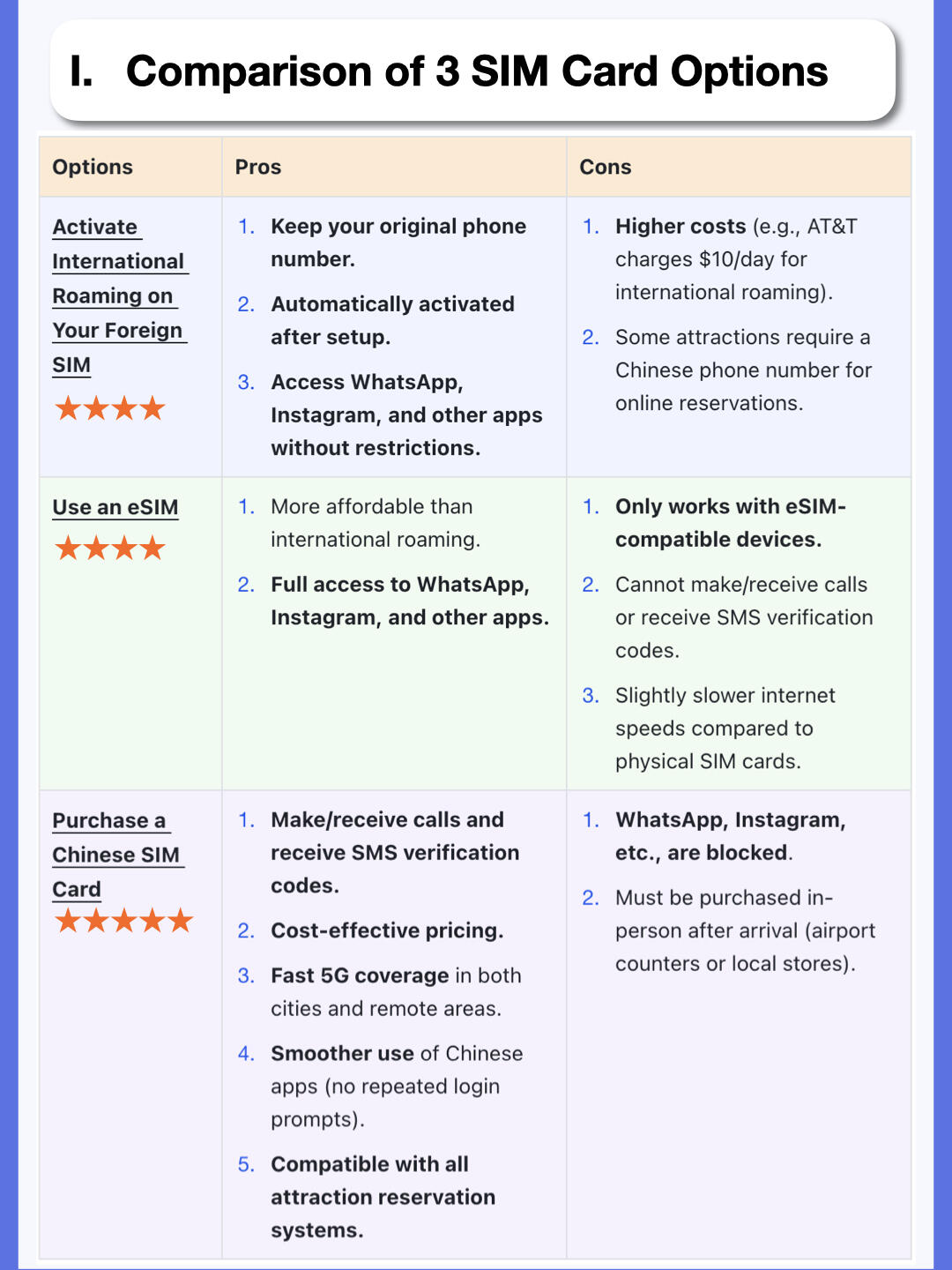
Comparison chart of roaming, eSIM, and Chinese SIM card. This is a good place to place your three-option comparison image.
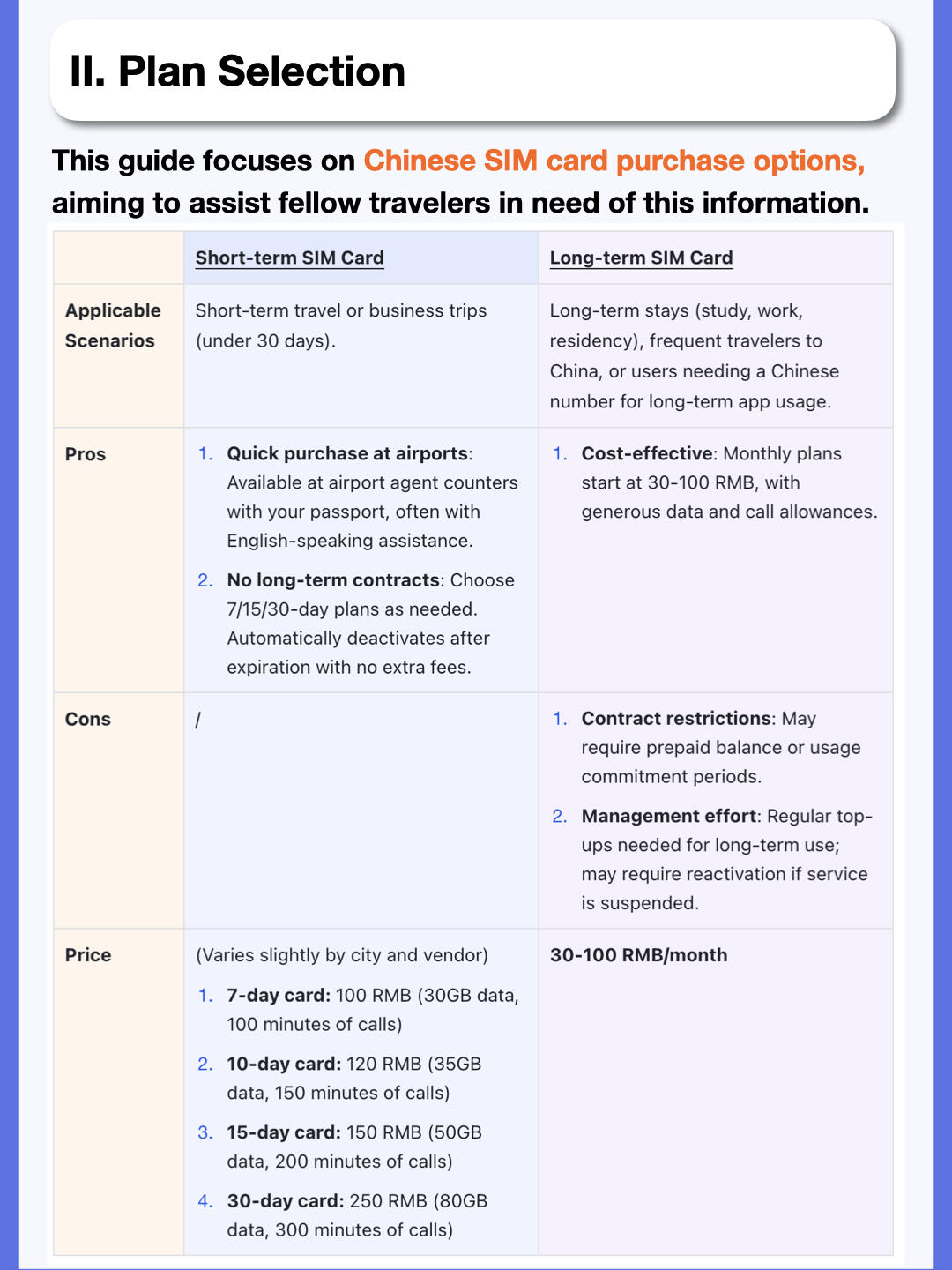
For most foreign travelers, Chinese SIM plans usually fall into two practical categories: short-term plans and longer-term plans. Beijing and Shanghai’s official guides show that major operators provide airport or service-hall collection options, which is useful for people arriving for tourism, business trips, study, or extended stays.
Short-term SIM cards
These are most suitable for:
trips under 30 days
business visits
tourists who want a Chinese number during the journey
Long-term SIM cards
These are better for:
study
work
residency
frequent trips to China
A practical rule is simple: if you are only visiting China once, a short-term plan is usually enough. If you will return often or stay for a longer time, a longer-term plan is more efficient. That is an inference from the way official operator and city guides separate tourist-friendly airport pickup services from longer-term service hall registration.
III. Where to Buy a Chinese SIM Card at the Airport
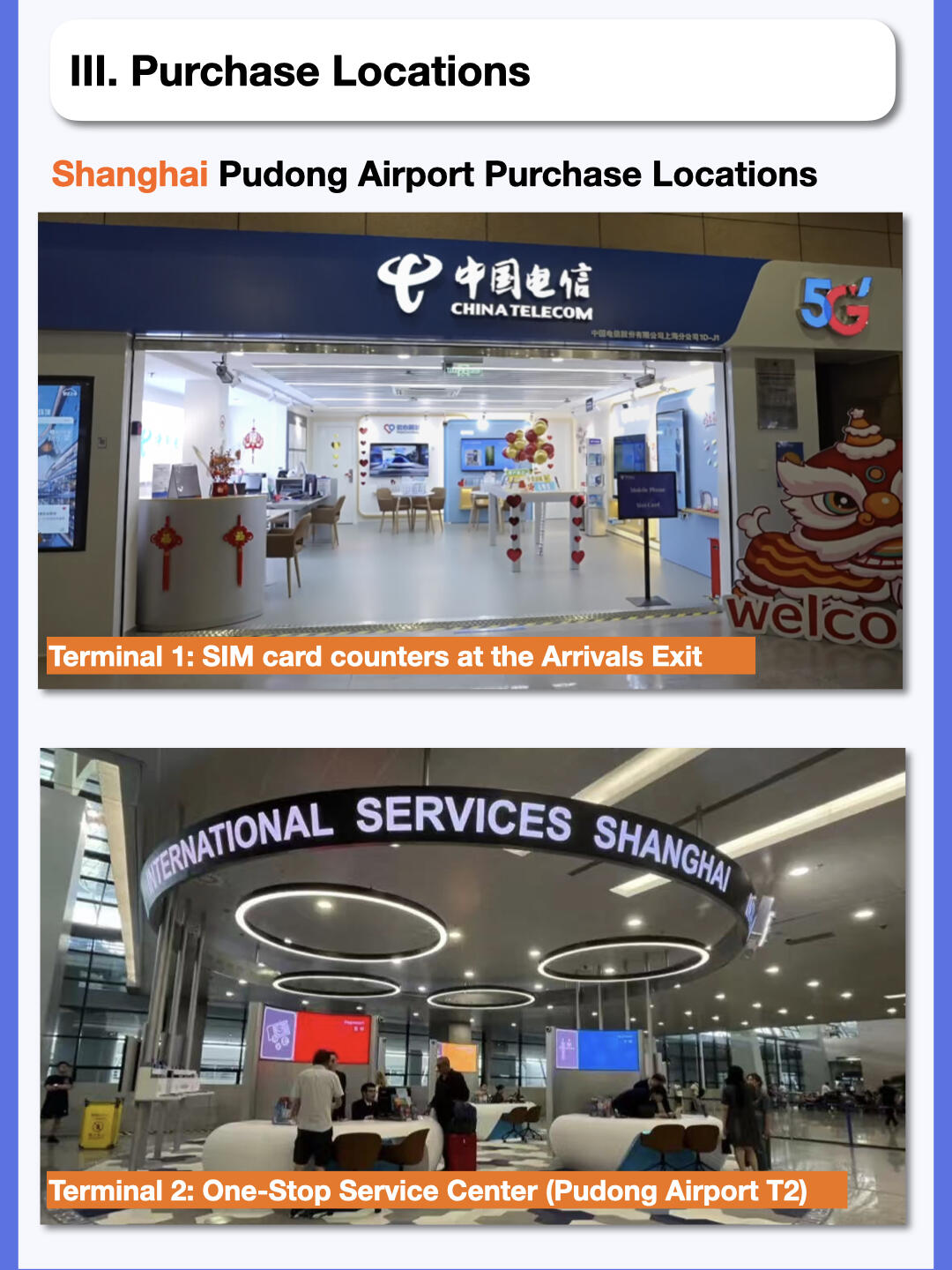
Shanghai Pudong Airport SIM card purchase location. Put your Shanghai screenshot here.
In Shanghai, the official airport operator page lists China Telecom service at Pudong Airport Terminal 1, near Gate 11 in the public area, with business hours from 07:00 to 22:00. The Shanghai municipal government also confirms that short-term SIM cards for foreigners are available at multiple outlets across the city.
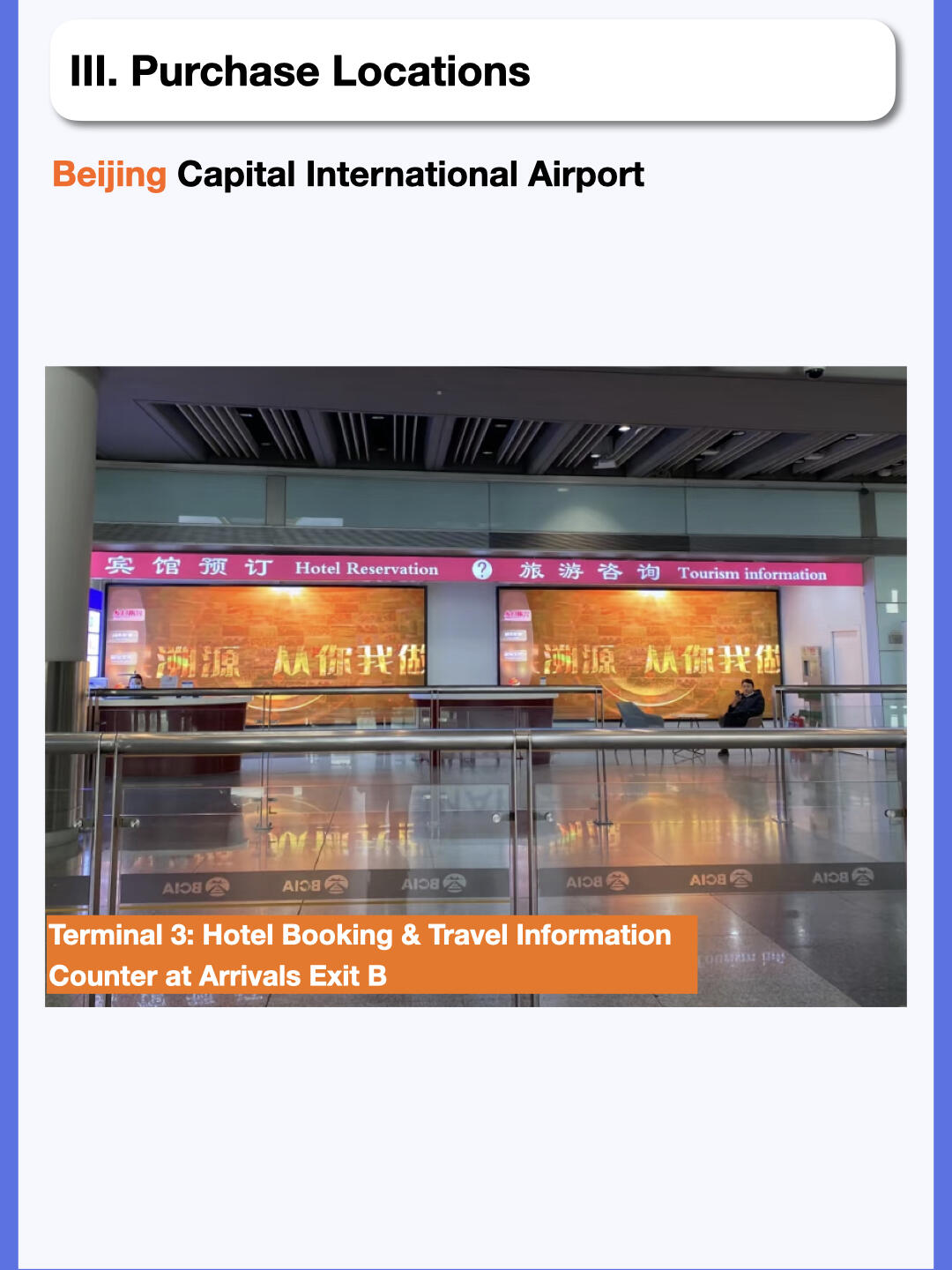
Beijing Capital International Airport SIM card service location. Put your Beijing screenshot here.
In Beijing, the municipal government states that foreigners can submit applications online and collect SIM cards offline at Beijing Capital International Airport or Beijing Daxing International Airport. It also notes that airport service counters can assist with collection and explain how to use the card.
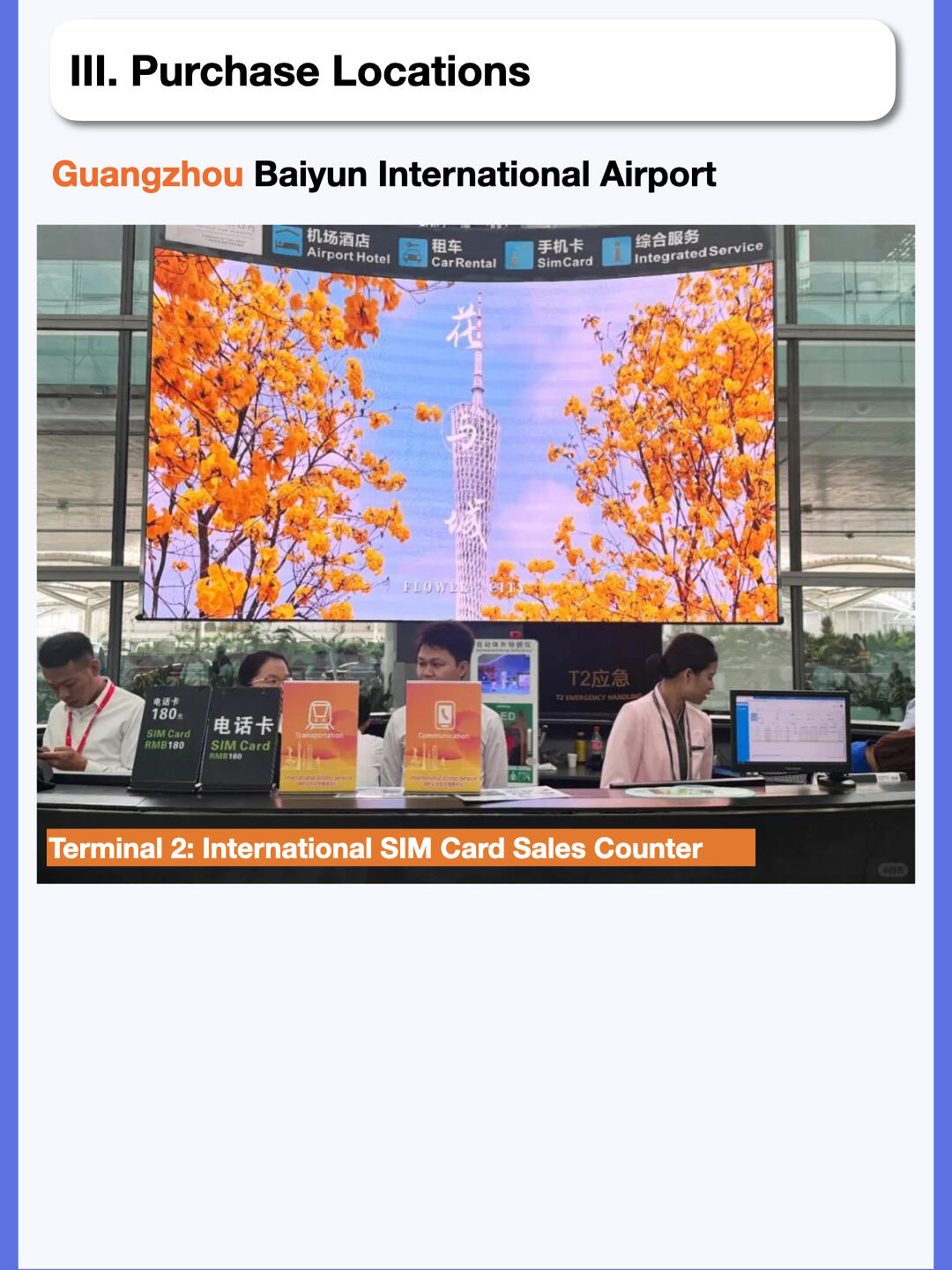
Guangzhou Baiyun International Airport SIM card counter. Put your Guangzhou screenshot here.
Chengdu Shuangliu International Airport SIM card counter. Put your Chengdu screenshot here.
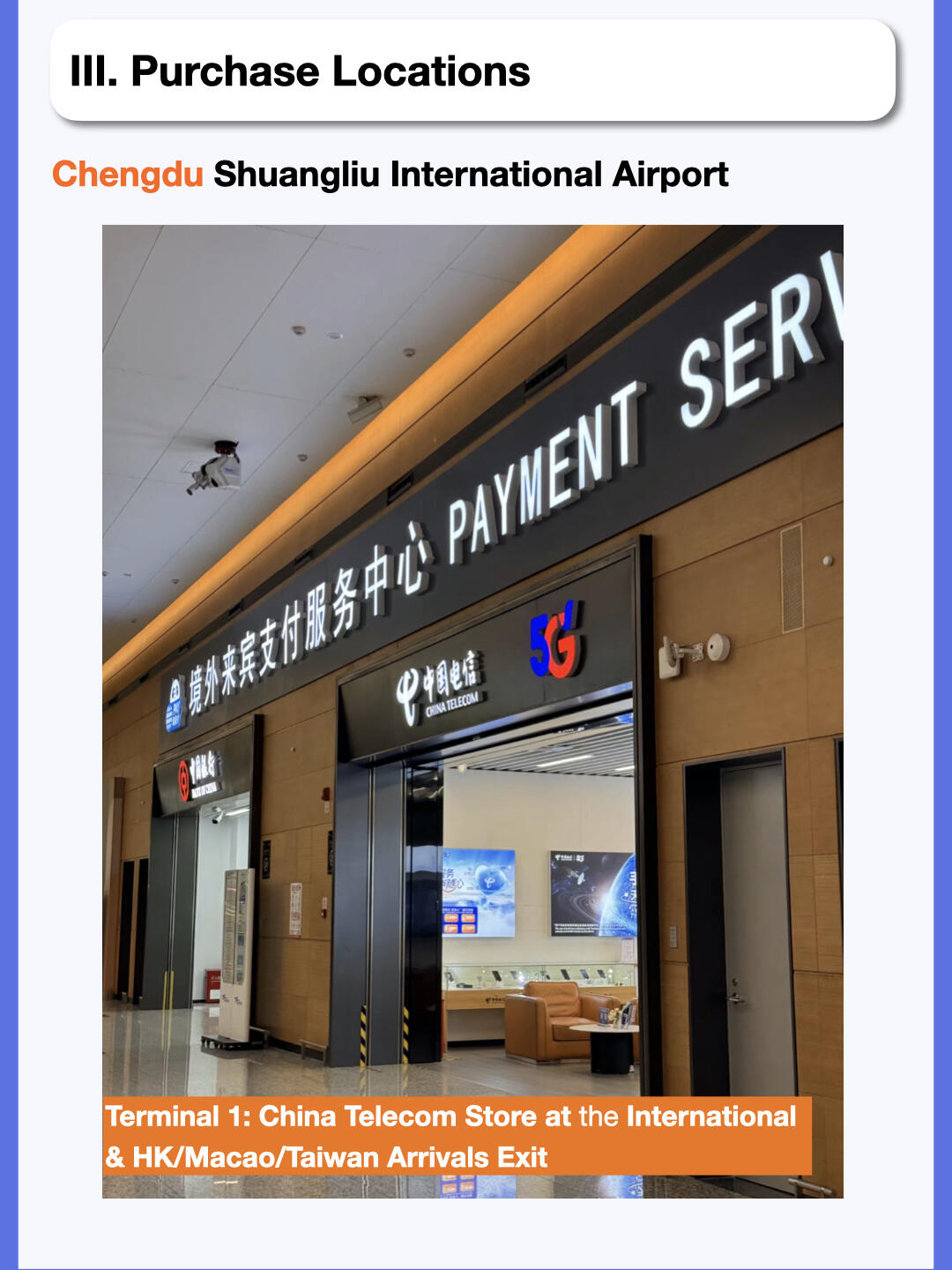
For Guangzhou and Chengdu, your own screenshots are the best source of the exact counter positions, because airport layouts can change and the counter names may differ by terminal. In the article body, it is safer to say that travelers should follow the “SIM Card,” “Integrated Service,” or telecom counter signs in the arrivals area, then confirm on-site with airport staff. That wording reflects the common airport-service model shown in Beijing, Shanghai, and Chengdu-related official or airport-linked guidance.
IV. What You Need to Prepare Before Buying
Chinese government guidance says foreigners should bring a valid passport for SIM activation and real-name registration. Shanghai’s education FAQ for foreigners also says the government requires real-name registration and recommends bringing the passport.
Please prepare:
passport
mobile phone
payment method
a few minutes for identity verification
If you are using a foreign device, make sure it is unlocked and able to use local networks. A Chinese SIM card only works properly if the phone can accept a local carrier’s service and complete the registration flow. That is a practical inference from the official passport-registration process and operator service descriptions.
V. How to Buy and Activate the SIM Card
Step-by-step purchase screen. This is a good place to show the telecom counter or application screen.
The normal process is straightforward:
Go to the airport counter or an official telecom service point.
Show your passport.
Choose a short-term or long-term plan.
Complete real-name registration.
Insert or activate the SIM card.
Test mobile data and SMS before leaving the counter.
This is consistent with official guidance from Beijing and Shanghai, which both describe airport collection or city service-hall registration for foreign users.
If your plan includes a Chinese phone number, it is useful for local calling and SMS-based verification. If you only need fast data, eSIM may be simpler. If you need a mainland number, airport pickup plus local SIM activation is usually the most practical route.
VI. Usage Scenarios: Which Option Fits Which Traveler?
Chinese SIM card
Best for travelers who:
stay in China for several days or longer
need a local phone number
want easy access to calls and SMS
prefer buying service after landing in China
eSIM
Best for travelers who:
want instant setup
have an eSIM-compatible phone
do not want to swap cards
mainly need data service
International roaming
Best for travelers who:
need to keep their original number
want the least setup before departure
do not mind paying more for convenience
VII. Common Questions
1. Do foreigners need a passport to buy a SIM card in China?
Yes. Official guidance says foreigners need passport-based real-name registration when activating a SIM card.
2. Can I buy a SIM card at the airport?
Yes. Beijing’s official government guide confirms airport pickup and collection. Shanghai’s official airport page also lists a telecom counter at Pudong Airport.
3. Is eSIM easier than a physical SIM?
For many travelers, yes. Apple describes eSIM as a built-in digital SIM, so you do not need to insert a physical card.
4. Which option is cheapest?
It depends on your carrier, trip length, and data needs. Roaming pricing varies by carrier, while local SIM and eSIM plans depend on the provider and package.
VIII. Final Advice for First-Time Visitors
If this is your first time in China, the most balanced choice is usually a Chinese SIM card or an eSIM. If you want the least friction at the airport and need a local number, a Chinese SIM card is usually the better long-term solution. If you only need fast internet and want to set everything up before departure, an eSIM may be enough. If you only care about keeping your home number alive, roaming is the simplest but often the most expensive route.
If you are landing in Xi’an and want help with airport pickup, hotel transfer, or mobile setup support after arrival, you can contact me on WhatsApp at +86 158 7753 7303.
Need a ride from Xi’an Airport?
Fixed-price private transfers with an English-speaking driver. Sedan from $40, Buick GL8 from $55. Flight tracking and name-sign pickup, day or night.
Helpful for Your Trip in Xi’an
Xi'an Airport Pickup | Xi'an Xianyang Airport Transfer | Private Tour Service
Right now, somewhere in Xianyang Airport, our driver is holding up a name sign for our foreign guests — taking them straight from the terminal t...
2026-08-15
Xi'an Airport Transfer Pricing
A Xi'an airport transfer is a one-way ride at a fixed price. Your driver waits at the arrivals exit with your name on a sign, helps with your bags...
2026-08-14
Xi'an Xian'yang Airport(XIY) Guides
Xi'an Xian'yang International Airport(IATA: XIY) is located 35km northwest of Xian city centre, the capital of China's Shaanxi Province. I...
2026-06-10
Xi'an Xian'yang Airport (XIY) Transfer Guide
There are Terminal 2 and Terminal 3 at Xi'an Xian'yang International Airport(XIY). For smooth transfer, it is recommended that passengers shou...
2026-06-10
China High-Speed Train Guide: Buy Tickets on 12306 and Board (2026)
How to Buy Tickets on 12306 and Board a TrainIf you are traveling in China for the first time, the railway system is one of the easiest ways to move b...
2026-05-16
How to Ride the Xi'an Metro: Alipay, WeChat Pay or Paper Ticket (2026)
Step-by-Step Guide to Taking the Subway in ChinaChina’s subway systems are one of the most convenient ways for foreign travelers to move around major...
2026-05-16
China SIM Card
Super Detailed Steps: How to Stay Connected After Arriving in ChinaStaying connected in China is one of the first problems foreign travelers need to s...
2026-05-16
How to Set up WeChat pay
WeChat Pay is one of the most practical tools for foreigners visiting Mainland China. Tencent says overseas users can link an international card to We...
2026-05-16
How to Use Alipay
Super Detailed Guide for ForeignersAlipay is one of the most practical payment tools for travelers in China. Alipay’s international version is designe...
2026-05-16